
A professional website for a small business in Australia usually costs a few thousand dollars to build, and the final price depends on how many pages you need, what the website has to do and how much of the content is written for you.
At JS Website Design, one-page websites start from $1,997 + GST and multi-page websites start from $4,500 + GST. If you would rather not pay it all up front, we also offer flexible payment plans over 12 or 24 months.
A good website is not just a cost, though. Built properly, it is an investment that keeps bringing in work for years. This guide explains what drives the price, the ongoing costs to plan for, and how to work out whether a new website will pay for itself.
A Good Website Is an Investment, Not Just a Cost
It is easy to think of a website as a bill you pay once and try to forget. The businesses that get the most from their website think about it differently.
A good website works for your business every day. It answers questions at 10pm, shows your best work to people you have never met, and sends enquiries to your inbox while you are on the job or with a client. That makes it much closer to an asset, like a work vehicle or good equipment, than an expense.
Like any asset, its value comes from what it produces over time. A website that brings in two or three good jobs a month can pay for itself many times over across the years it is live, while a cheap website that brings in nothing is money spent with no return.
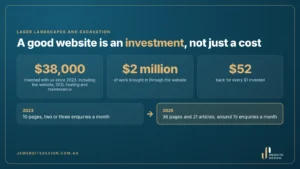
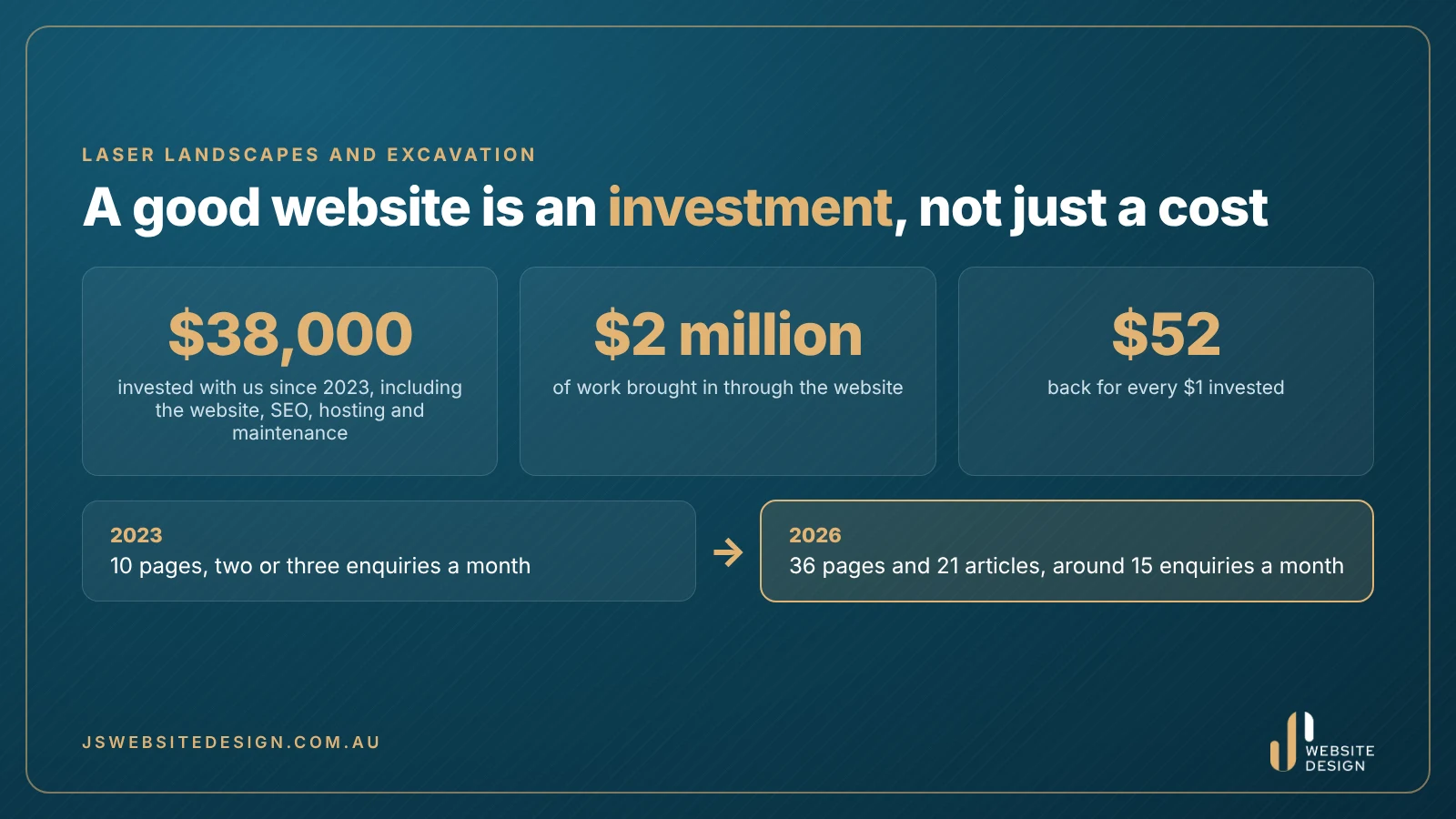
A good website also grows in value the longer you have it. Every page you add, every review you collect and every month it ranks on Google adds to what it can do for you. Laser Landscapes started with a 10-page website in 2023 and has grown it to 36 pages and 21 articles, and it now brings in around 15 enquiries a month, up from two or three in its first year.
So the better question is not only “how much does a website cost?” but “what will this website bring back to my business?” The rest of this guide helps you answer both.
The Main Ways to Get a Website, and What Each Costs
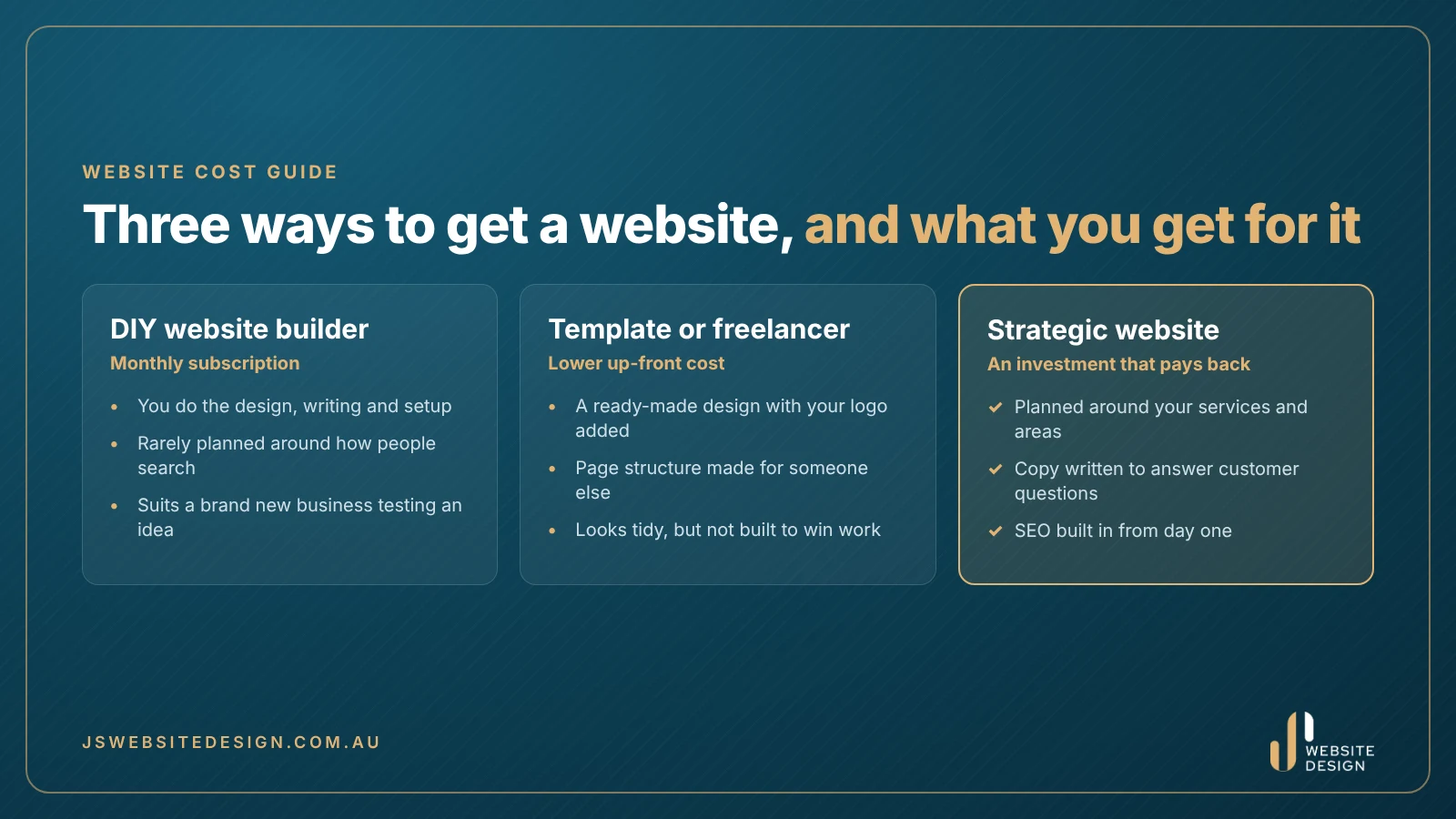
There are three common ways to get a website, and each one suits a different stage of business.
A DIY website builder
Platforms like Wix, Squarespace and GoDaddy let you build a website yourself for a monthly subscription. This is the cheapest way to get online, and it can suit a brand new business testing an idea.
The real cost is your time. You do the design, the writing, the photos and the setup for Google yourself, and most business owners have better things to do. Brownjohn Constructions ran a DIY Wix website for two years without a single lead, which is a common story. Our article on the real cost of DIY websites goes into more detail.
A template website or freelancer
A template website takes a ready-made design and adds your logo, colours and text. It is quicker and cheaper than a custom build, and a good freelancer can produce something tidy.
The limit is that the design and page structure were made for someone else. You get a website that looks fine, but it is rarely planned around the services you want more of or the searches your customers use.
A strategic website built for your business
A custom build starts with your business, not a template. The pages are planned around your services, your areas and your customers, the copy is written to answer their questions, and SEO is built in from the start.
This costs more up front, but it is the option most likely to bring in enquiries. It is how we build every website at JS Website Design.
What Changes the Price of a Website
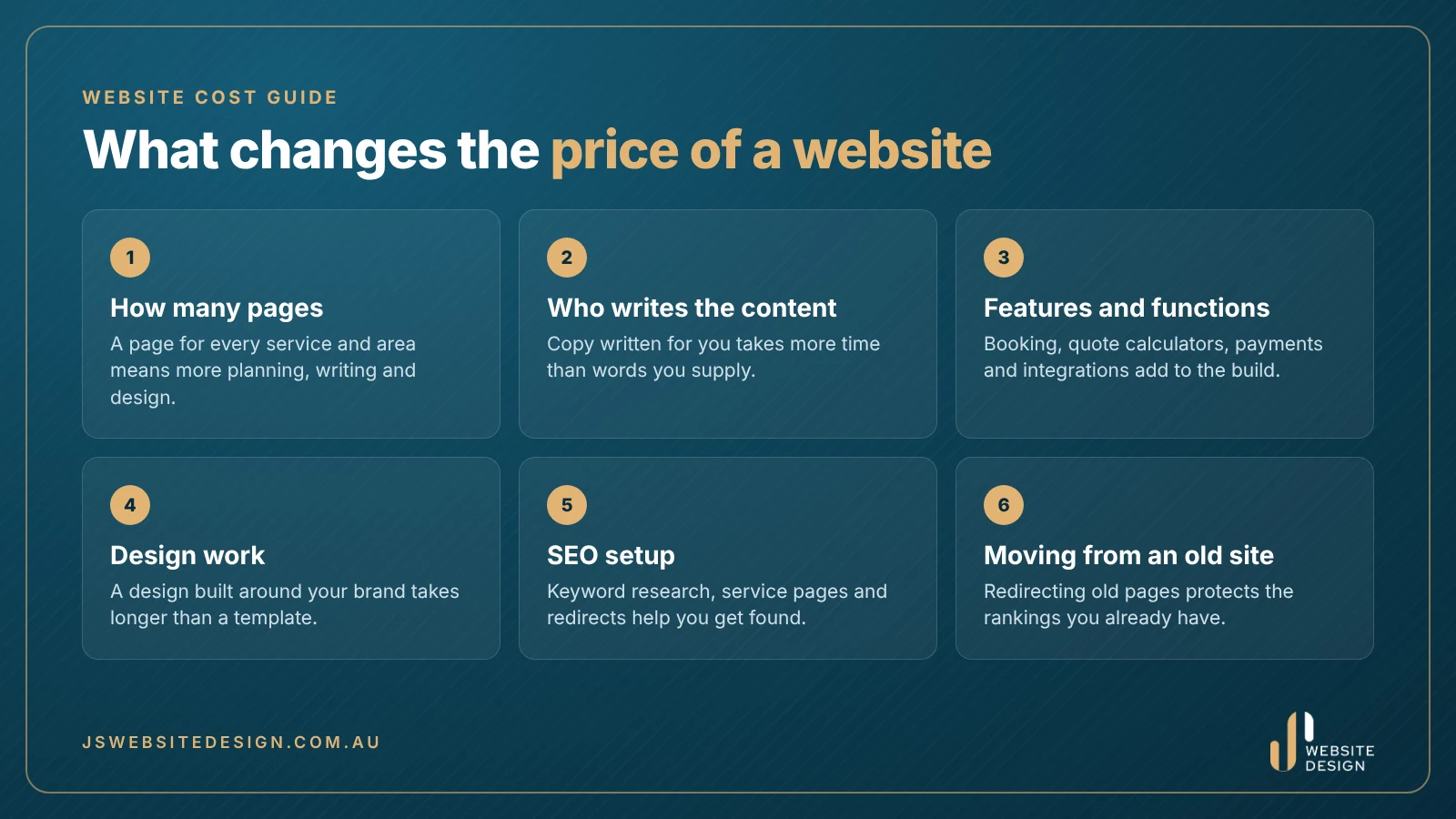
Two websites can look similar on the surface and still be very different jobs. These are the things that make the biggest difference to the price.
How many pages you need. A one-page website for a new business is a much smaller job than a website with a page for every service and every area you work in. Each page needs planning, writing, design and testing.
Who writes the content. Writing good website copy takes time. If you supply all the words yourself, the price is lower than if your web designer researches and writes them for you.
Features and functions. Booking systems, quote calculators, online payments, member areas and integrations with other software all add to the build. An online store with hundreds of products is a different project again.
Design work. A website built around your brand, your photos and your customers takes more design time than one that adds your logo to a template.
SEO setup. A website planned around keyword research, with service and location pages, page titles and redirects from your old website, costs more to build than one that skips it. It also tends to be found far more often on Google.
Moving from an old website. If you already have a website with rankings, redirecting the old pages properly protects what you have built. It is a small part of the cost, and skipping it can lose rankings you spent years earning. Our website redesign page shows how we handle this, with real before and afters.
What Should Be Included in the Price
When you compare quotes, make sure you know exactly what each one covers. A professional website build should usually include:
- A plan for the pages, based on your services and how your customers search
- A design that works on phones, tablets and desktops
- Help with the words on each page, or the full copy written for you
- Contact or quote forms that send enquiries straight to your inbox
- Basic SEO setup, including page titles, descriptions and redirects from your old website
- Speed and security checks before launch
- Training so you can make simple updates yourself
- A website you own once it is paid for
As a guide, every website we build includes keyword research, a page structure planned around your services and areas, phone-friendly enquiry forms, SEO built in from day one and redirects from your old pages.
The Ongoing Costs to Plan For
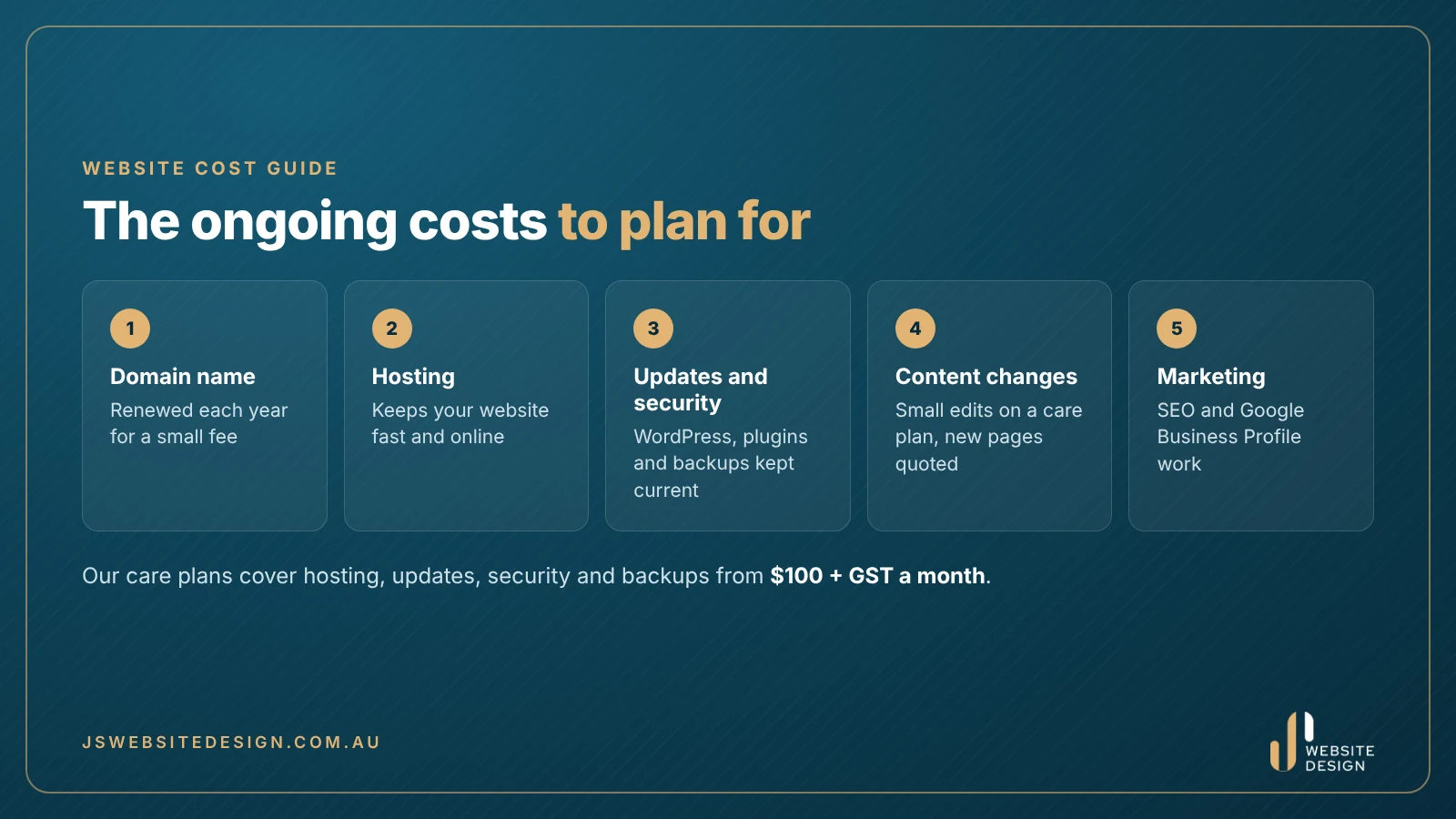
The build is the biggest cost, but it is not the only one. These are the ongoing costs most business owners need to plan for.
Domain name. Your website address, such as yourbusiness.com.au, is renewed each year for a small fee.
Hosting. Your website has to live on a server, and good hosting keeps it fast and online. Cheap shared hosting is often slow, and a slow website loses visitors.
Updates, security and backups. WordPress, its plugins and its security settings need regular updates. Left alone, a website can slow down, break or get hacked, which usually costs far more to fix than it would have cost to look after.
Content changes. Prices change, services grow and new projects need adding. Small changes are often covered by a care plan, while bigger work such as new pages is quoted separately.
Marketing. A website does not bring in work on its own forever. Many businesses add ongoing SEO or Google Business Profile work once the website is live, so it keeps climbing on Google.
Our website care plans cover hosting, updates, security and backups, and start from $100 + GST a month. About 70% of the businesses we build for stay on one, because it means they never have to think about the technical side.
Spreading the Cost With a Payment Plan
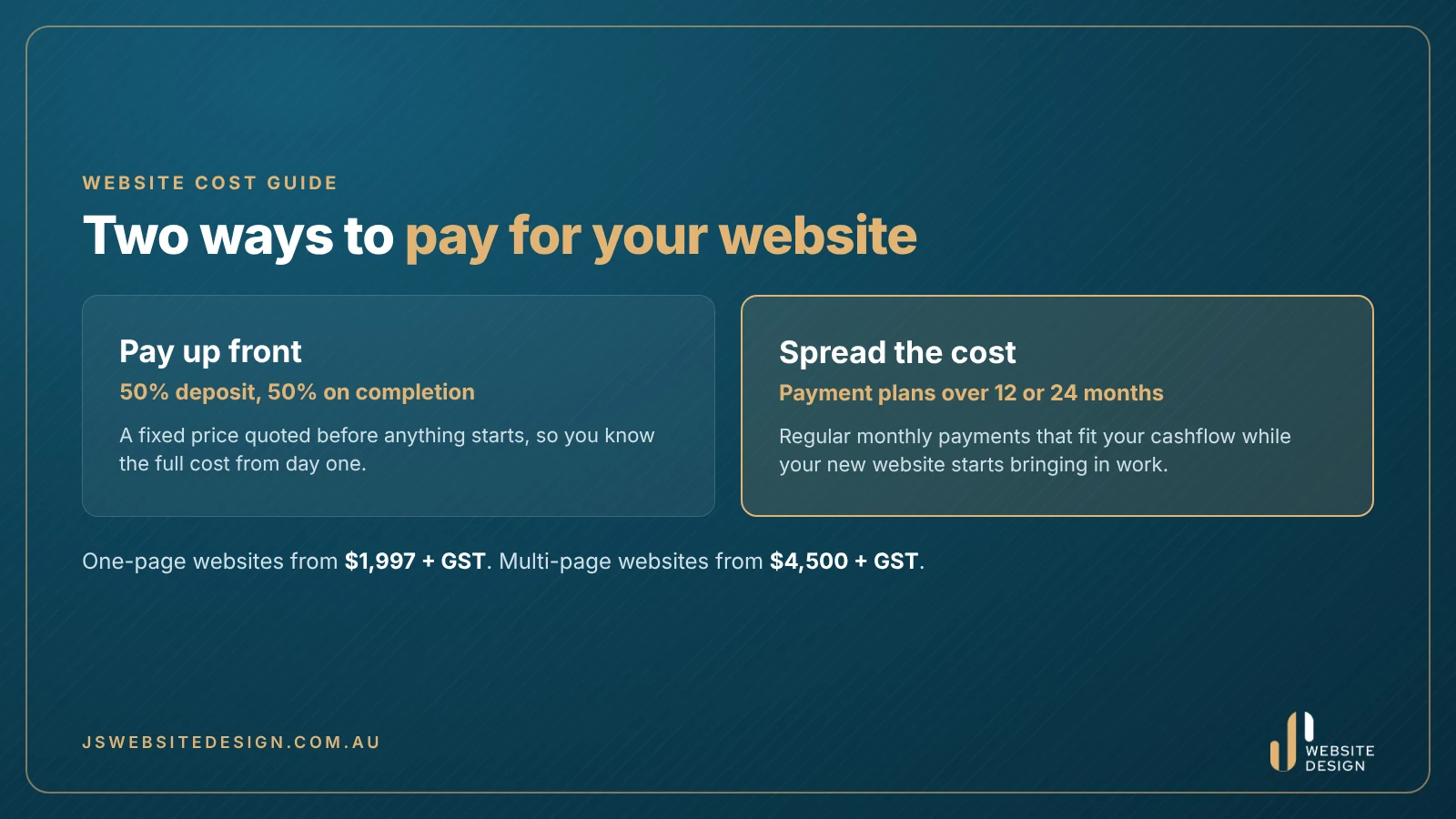
A new website is an investment, and not every business wants to pay for it all at once.
That is why we offer flexible payment plans over 12 or 24 months. Instead of a large up-front payment, you spread the cost of your website into regular monthly payments, so it fits your cashflow while the website starts bringing in work.
If you prefer to pay up front, our standard terms are a 50% deposit to begin and 50% when your website is finished. We will talk you through both options before anything starts, so you can choose the one that suits your business.
Why the Cheapest Website Often Costs More
It is tempting to choose the lowest quote, especially when two websites look similar in the design mock-up.
The difference usually shows up later. A cheap website is often built without any thought for how customers search, so it rarely shows up on Google. It may be slow on a phone, hide the contact form or leave visitors unsure what to do next. Many businesses end up paying for a second website a year or two later, which costs far more than getting it right the first time.
Soldani Projects had been through three websites that never brought in a single lead before they came to us. That is three websites paid for, and nothing to show for any of them.
That does not mean you need the most expensive option. It means the price should match what the website needs to do for your business, and you should be able to see exactly what you are paying for. We cover this in more detail in the ROI of a professional website.
Is a New Website Worth the Cost?
A website is worth it when the work it brings in is worth more than it costs. The simplest way to check is to work backwards from the value of a new customer.
Say an average new customer is worth $2,000 in profit to your business. A $4,500 website needs to bring in three extra customers to pay for itself, and every customer after that is a return. Over the years a website is live, most businesses need far fewer enquiries than they expect to cover the cost.
Here is what that has looked like for some of our clients:
- Brownjohn Constructions went from no leads on a DIY website to an enquiry on launch day and a job in the first week, and has had 53 enquiries since. Read the Brownjohn case study.
- Soldani Projects received 14 enquiries and more than $100,000 of work in under five months from their new website. Read the Soldani case study.
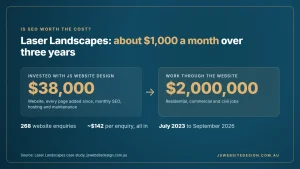
- Laser Landscapes and Excavation has invested $38,000 with us since 2023, covering the website, every page added since, SEO, hosting and maintenance. The website has brought in $2 million of work in that time, which is about $52 back for every $1. Read the Laser Landscapes case study.
Questions to Ask Before You Sign
A few simple questions will tell you a lot about any web design quote.
What exactly is included? Ask for the number of pages, who writes the content, and whether SEO setup and redirects are part of the price.
Will I own the website? You should own your website and everything on it once it is paid for. Be careful with providers who keep ownership or make it hard to move.
What platform is it built on? WordPress is used on a large share of the world’s websites and you can move it to another provider if you ever need to. Some custom platforms lock you in.
What are the ongoing costs? Ask what hosting, updates and support will cost each month once the website is live, so there are no surprises.
Can I see real results? Look for case studies with real numbers, not just screenshots of nice designs.
Are payment plans available? If spreading the cost would help your cashflow, ask whether it is an option before you rule out the website you really need.
How Much Does a Website Cost With JS Website Design?
Our one-page websites start from $1,997 + GST, and multi-page website design starts from $4,500 + GST. Most service businesses choose a multi-page website, so each service and key area can have its own page.
Every website is quoted at a fixed price, so you know the full cost before anything starts. You can pay with a 50% deposit and 50% on completion, or spread the cost with a flexible payment plan over 12 or 24 months.
Since 2017 we have built more than 100 websites for service businesses, including websites for tradies, builders, accountants and local businesses across Western Sydney, the Blue Mountains and Australia wide.
Website Cost FAQs
How much should a small business pay for a website?
Most small service businesses in Australia should expect to invest a few thousand dollars in a professional website. Our one-page websites start from $1,997 + GST and multi-page websites from $4,500 + GST, and the right budget depends on how many services and areas you need pages for.
Is a website a cost or an investment?
A good website is an investment. The build is a cost up front, but a website planned around your customers keeps bringing in enquiries for years, so it can pay back many times what you spent. A website that brings in nothing is only a cost, which is why the planning matters as much as the price.
Can I pay for my website in instalments?
Yes. We offer flexible payment plans over 12 or 24 months, so you can spread the cost of your website into regular monthly payments. If you prefer to pay up front, our standard terms are a 50% deposit and 50% on completion.
How much does a website cost per month?
Once your website is built, the main monthly costs are hosting, updates and security. Our care plans cover all three and start from $100 + GST a month. If you choose a payment plan for the build, those monthly payments are separate.
Can ChatGPT or AI build my website?
AI tools can help you draft words or generate a basic page, but they cannot plan a website around your business, check what your customers search for, or make sure it is fast, secure and set up properly for Google. They work best as a helper, not a replacement for a website built with a clear plan.
Why do website quotes vary so much?
Quotes vary because they often cover very different amounts of work. One quote might be a template with your logo added, while another includes keyword research, copywriting, SEO setup and redirects. Always compare what is included, not just the price.
Want a Clear Price for Your Website?

Book a free website review and we will look at your current website, talk through what you need, and give you a clear idea of what your new website would involve and what it would cost, including what a payment plan would look like. There is no obligation to go ahead.