
Local SEO is the work that helps your business show up when people nearby search for what you do, both in the Google Maps results and in the normal results below them.
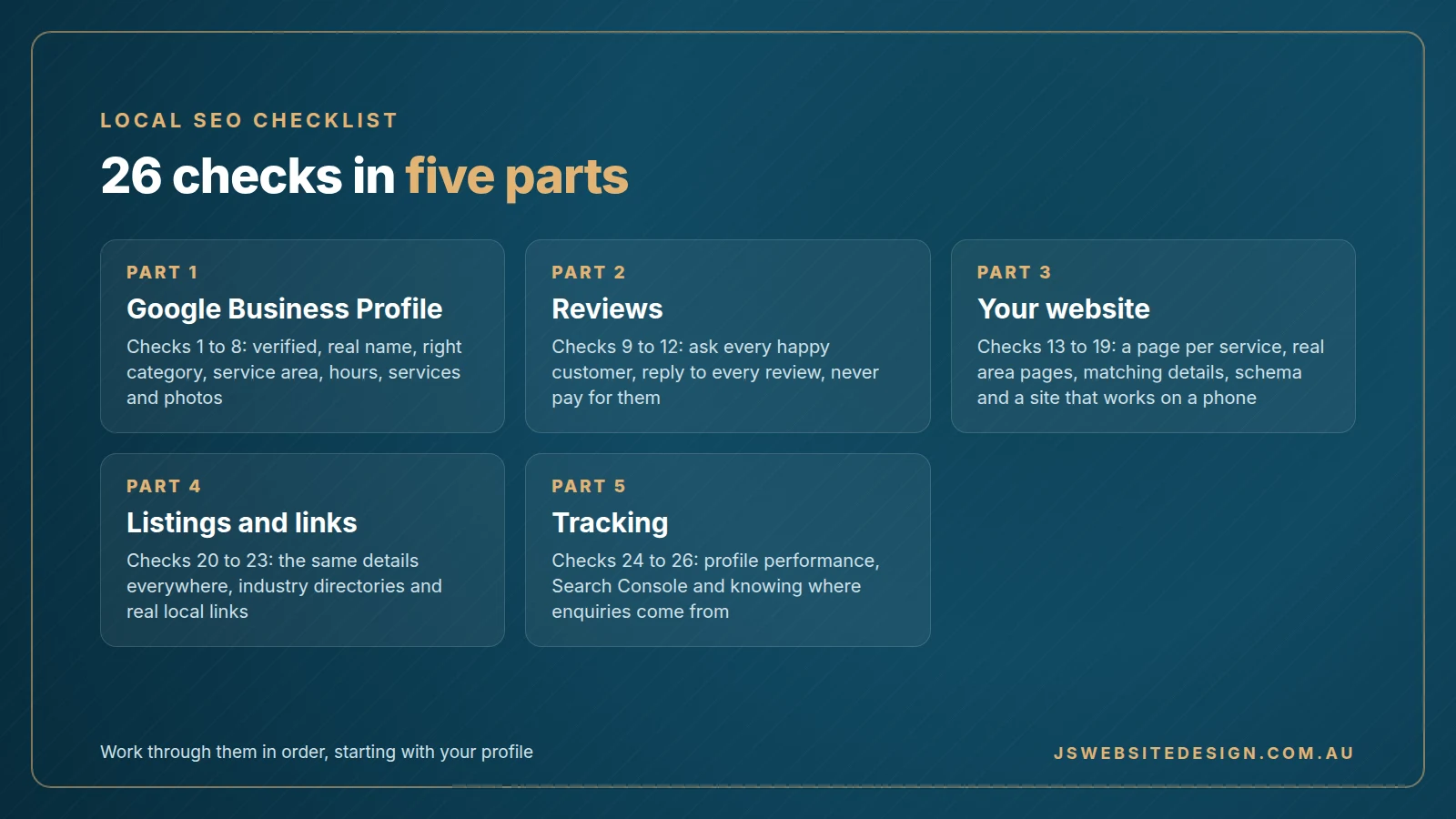
This checklist covers the 26 things we check first when a local business asks us why they are not showing up. It is split into five parts, starting with the ones that usually make the biggest difference, so you can work through it in order and stop when you run out of time.
Most of it you can do yourself. Where something is easier with help, we will say so.
How Google decides who shows up locally
Before the checklist, it helps to know what Google is looking for. According to Google’s own guidance, local results are mainly based on three things.
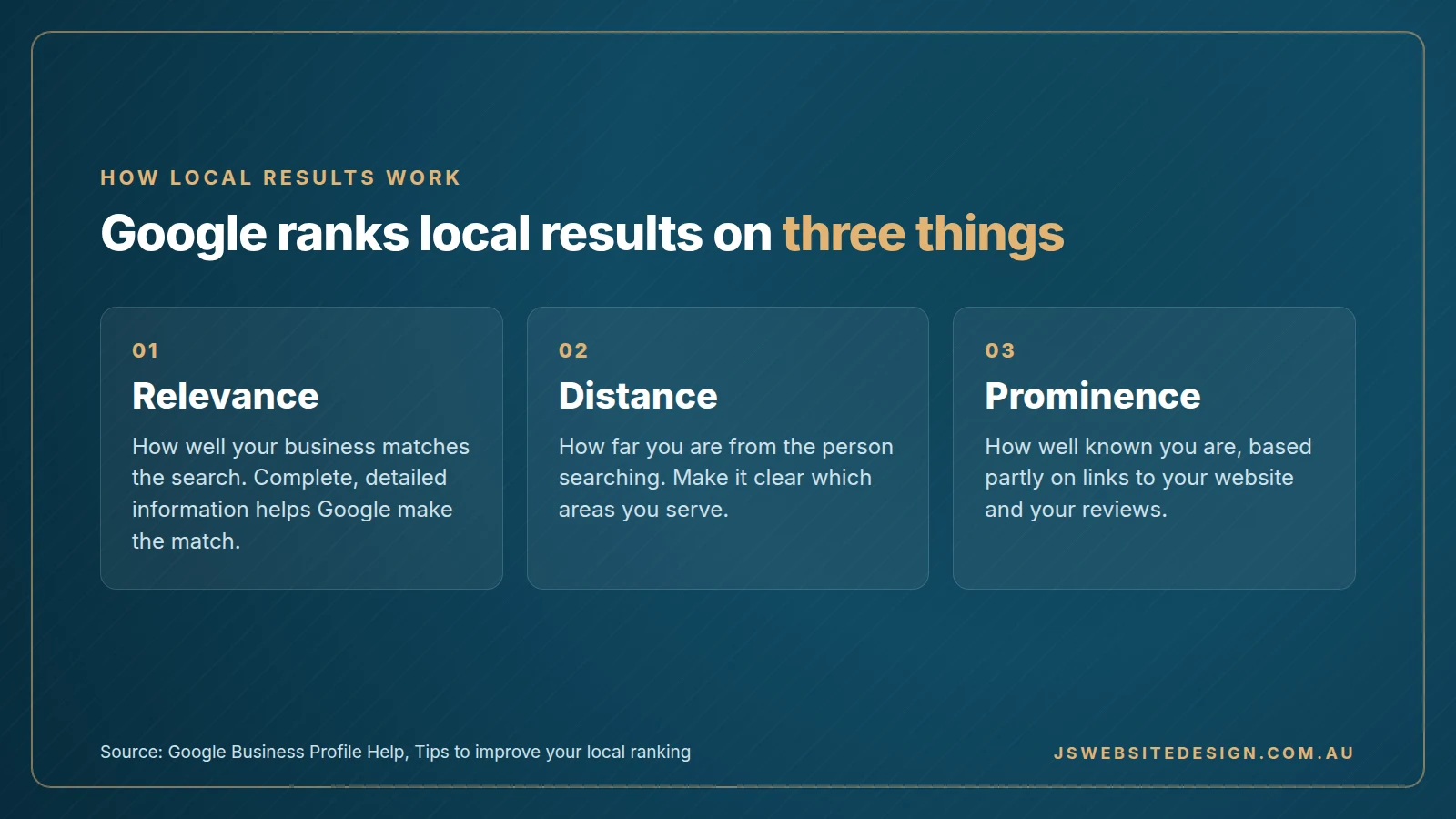
Relevance is how well your business matches the search. Google can only match you to searches it understands, which is why complete, detailed information matters so much.
Distance is how far your business is from the person searching. You cannot change where you are, but you can make it clear which areas you serve.
Prominence is how well known your business is. Google says this is based partly on how many websites link to you and how many reviews you have.
Every item in this checklist improves at least one of those three. Google is also clear that there is no way to pay for a better local ranking, so the work below is the only way in.
Part 1: Your Google Business Profile
Your Google Business Profile is the listing that appears in Google Maps and the map results. For most local searches it shows up before any website, so it is the best place to start.
1. Your profile is verified. Google says verification tells it you are authorised to represent the business, which makes the profile more likely to show up. An unverified profile may not show up at all, so check this first.
2. Your business name is your real business name. Adding suburbs or services to your name, such as “Smith Plumbing Penrith Blocked Drains”, breaks Google’s guidelines and can get your profile suspended. Use the name on your signage, invoices and website.
3. Your primary category is the closest match to what you do. The primary category has a big effect on which searches you show up for. Pick the most specific option that describes your main service, then add secondary categories for the other work you do.
4. Your service area matches where you actually work. If customers do not visit you, hide your address and list the suburbs or regions you travel to. Google’s guidelines say a service area should generally stay within about two hours’ drive of where you are based.
5. Your hours are accurate, including public holidays. Google says complete and accurate information makes you more likely to show up, and a customer who turns up to a closed door will not give you a second chance.
6. Every service is listed with a short description. List each service you want work from, in the words your customers use. This gives Google more to match against and tells people straight away whether you do what they need.
7. You add real photos regularly. Photos of your work, your team, your vehicles and your premises show people you are a real business. Stock images do the opposite. Adding new photos every month or two also keeps the profile looking current.
8. Your website link goes to the right page. For a single-location business this is usually your home page. If you have more than one location, each profile should link to the page for that location.
Our guide to optimising your Google Business Profile and the five most common Google Business Profile mistakes go into each of these in more detail.
Part 2: Your reviews
Reviews help with prominence, and they are often the reason someone picks you over the business next to you in the map results.
9. You ask every happy customer for a review. Most people are happy to leave one if you ask at the right time, which is usually just after the job is finished and they have told you they are pleased. Send them the direct review link from your profile so it takes ten seconds.
10. You reply to every review, good and bad. Google says replying shows that you value feedback. A calm, helpful reply to a negative review often does more for your reputation than the review did damage.
11. You never pay or offer discounts for reviews. Google does not allow incentives for reviews, and it does remove reviews and restrict profiles that break the rules. A steady trickle of genuine reviews is worth far more than a sudden burst of suspicious ones.
12. Your best reviews also appear on your website. People who find your website first want the same reassurance. If you work in health, check the Ahpra rules before you do this, because testimonials about treatments are not allowed in advertising.
Part 3: Your website
Your Google Business Profile gets you seen, and your website is what convinces people to get in touch. It also gives Google most of the information it uses to judge relevance.
13. Every main service has its own page. A single “Services” page with a list of everything you do gives Google very little to work with. A page for each service, written around how people search for it, gives you a chance to rank for each one.
14. You have pages for the areas you serve, with real local detail. Area pages work when they show real jobs, local landmarks and the problems people in that area actually have. Copying the same page fifty times and changing the suburb name rarely works and can hold the rest of your website back.
15. Your business name, address and phone number match your profile exactly. Put them in your website footer and on your contact page, written exactly as they appear on your Google Business Profile, including the same abbreviations.
16. Your page titles include the service and the area. The page title is the blue link people see in Google. “Roof Restoration Penrith | Your Business Name” tells Google and the searcher exactly what the page is about.
17. Your website has local business schema. Schema is a small block of code that tells Google your business type, address, hours and service area in a format it reads easily. Google explains it in its local business structured data guide. Most good WordPress SEO plugins can add it for you.
18. Your website works properly on a phone. Most local searches happen on a phone, often when someone needs help soon. If your pages are slow, the text is tiny or the contact button is hard to find, people go back to the search results and choose someone else.
19. Getting in touch is easy on every page. A clear button and a short form on every page, plus a phone number people can tap, means interested visitors do not have to hunt for the next step.
Part 4: Your listings and links
Listings and links from other websites help Google confirm your business is real and well known, which feeds into prominence.
20. Your details are the same on every directory. Check the main Australian listings, such as Apple Business Connect, Bing Places, Yellow Pages, True Local and Hotfrog, and make sure your name, address and phone number match your Google profile exactly. Old addresses and phone numbers on forgotten listings are one of the most common problems we find.
21. You are listed in the directories for your industry. Trades often benefit from listings on sites like hipages or Oneflare, and health practices from HotDoc or HealthEngine. Industry associations usually have a member directory too, and those listings carry weight because they are hard to fake.
22. You have links from real local connections. Suppliers you buy from, associations you belong to, local sports clubs you sponsor and community groups you support can often link to your website. These local links are worth far more than any number of links from websites unrelated to you or your area.
23. You never buy links in bulk. Packages that promise hundreds of links for a small fee are almost always low quality, and they can do more harm than good.
Part 5: Your tracking
If you do not measure it, you cannot tell whether any of the work above is paying off.
24. You check your Google Business Profile performance each month. Your profile shows how many people called you, clicked through to your website or asked for directions. These numbers are often the clearest sign that local SEO is working.
25. You have Google Search Console set up. Search Console shows which searches your website appears for and where it ranks, including the local searches with your suburb in them. It is free and takes a few minutes to set up.
26. You know where your enquiries come from. Ask every new customer how they found you, and make sure your website forms are counted properly. Without this, it is easy to stop doing the work that is bringing in the most business.
What happens when the checklist is done properly
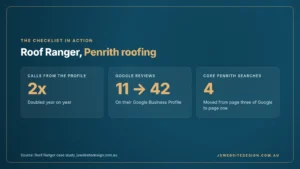
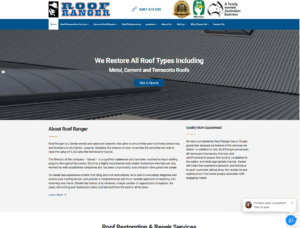
Roof Ranger, a roofing business in Penrith, is a good example. We worked through the profile, review and website parts of this checklist with them, including a new website with a page for each service and area.
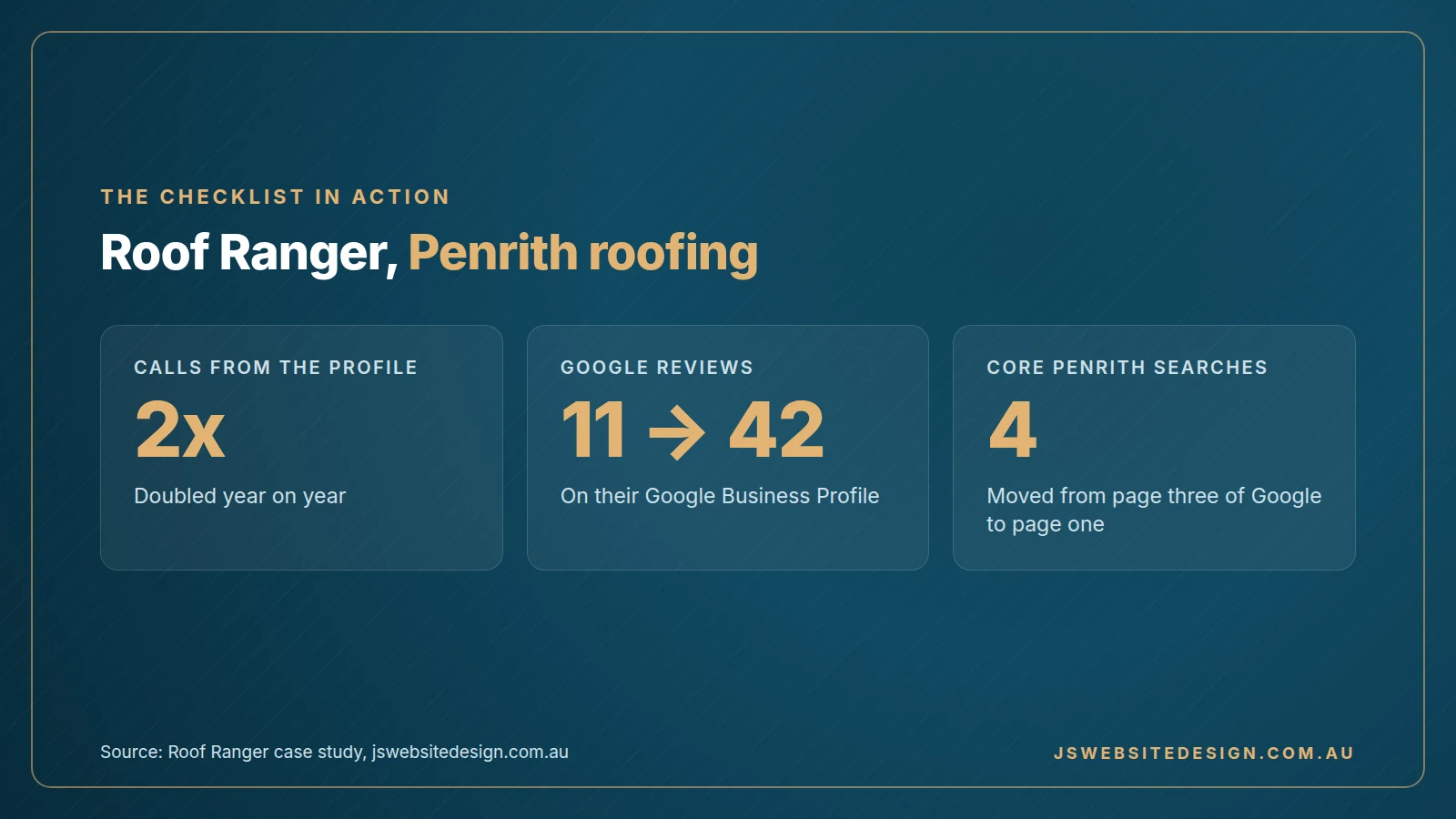
Calls straight from their Google Business Profile doubled year on year, their reviews grew from 11 to 42, and four of their core Penrith searches moved from page three of Google to page one. You can read the full Roof Ranger case study to see how it was done.
Schofields Accountants saw the same pattern in a very different industry. Calls from their profile rose from 96 to 142 in twelve months, and they now hold 68 reviews at a 5.0 star average. Their story is in the Schofields Accountants case study.
What to do first if you are short on time
You do not have to do all 26 at once. If you only have an afternoon, these five usually make the biggest difference.
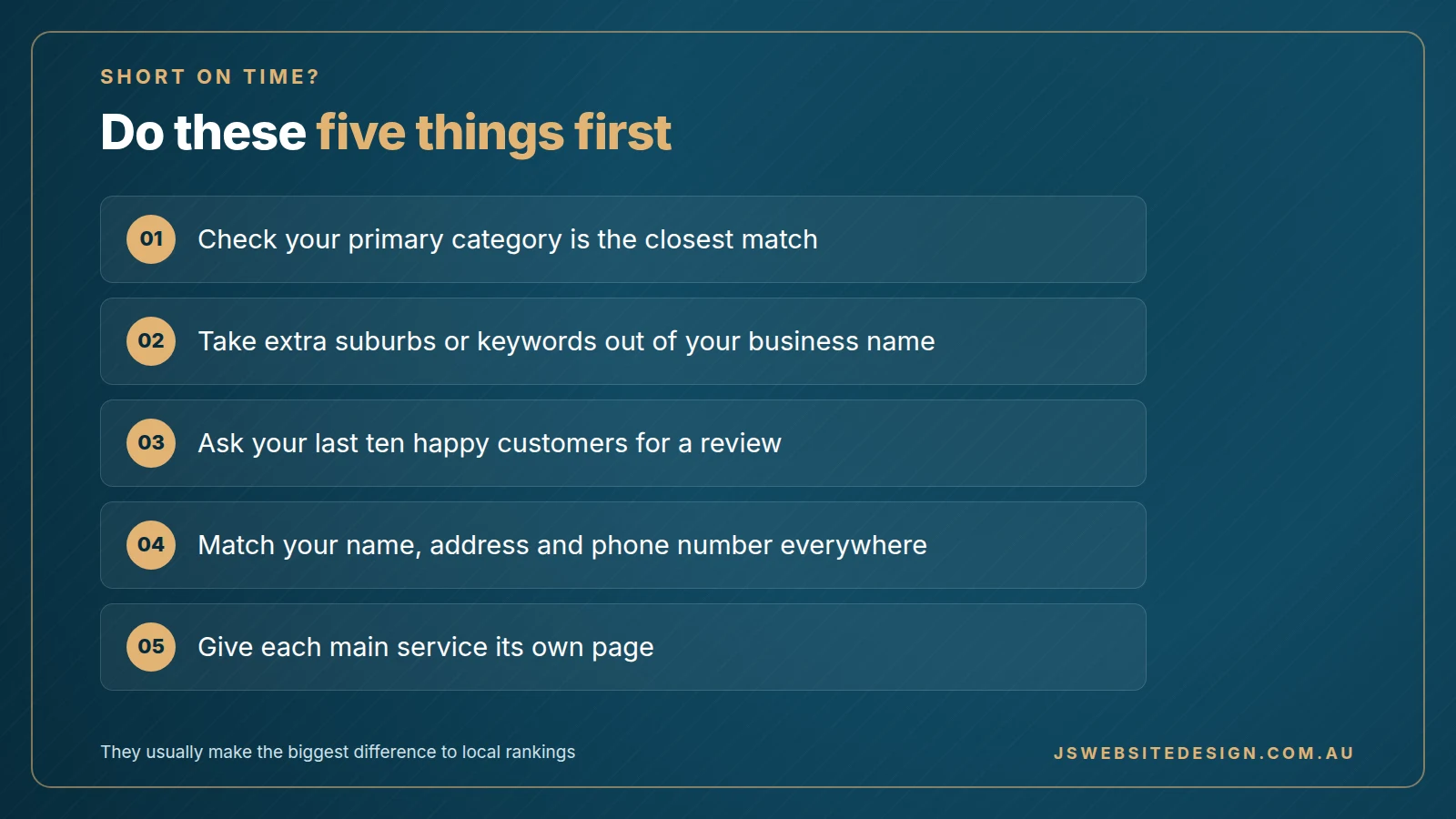
- Check your primary category is the closest match to your main service.
- Make sure your business name has no extra suburbs or keywords in it.
- Send a review request to your last ten happy customers.
- Check your name, address and phone number match on your profile, your website and your top three directory listings.
- Make sure your main services each have their own page on your website.
Local SEO builds over time. Most businesses start to see movement within three to six months, and it usually takes six to twelve months to see the full results, much like the gym, where the change is gradual but keeps building if you stick with it.
Can you do local SEO yourself?
Yes, most of this checklist is something a business owner can work through without technical skills. The profile, reviews, photos and directory listings mostly take time rather than expertise.
Where people usually get stuck is the website side, such as writing service and area pages that rank, adding schema and fixing technical problems. It is also hard to know which items matter most for your business without seeing your data. That is where an SEO audit or ongoing local SEO help can save you months of guessing.
If you are wondering what that help costs, our guide to how much SEO costs in Australia sets out real prices and what you should get for them.
Want us to run this checklist for you?

Book a free review and we will check your Google Business Profile, your website and your listings against this checklist, then tell you plainly what is holding you back and what we would do first.